Completion Rate Transformation (+110%)
InputCoach — Adaptive Form Intelligence Platform
Vertex Enterprise Solutions
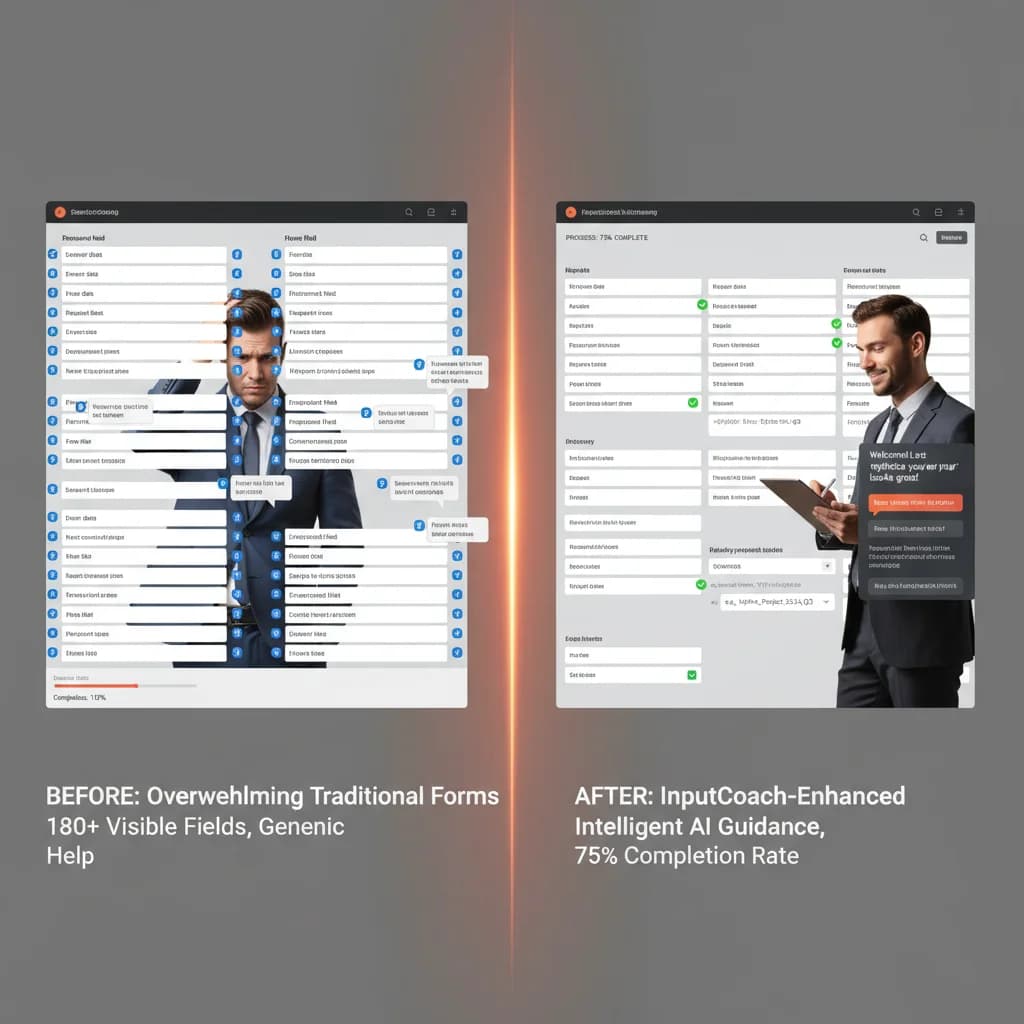
Transforming a 180+ field enterprise onboarding form from 39% completion to 82% with AI-powered contextual guidance, intelligent validation, and adaptive questioning.
Quick Facts
Vertex Enterprise Solutions
Vertex provides supply chain optimization software for Fortune 1000 manufacturers across automotive, aerospace, and industrial sectors. Their platform manages operations across 40+ countries with 1,000+ supplier relationships, requiring comprehensive onboarding with detailed configuration data.
The Stakes
61% of customers stalled during onboarding, causing delayed implementation timelines, overwhelmed sales engineering resources, and millions in deferred revenue.
Vertex represents a common enterprise challenge: necessary complexity creates friction. Their data requirements were legitimate — they needed intelligent guidance, not simplification.
The Onboarding Bottleneck
61% of Vertex customers abandoned the configuration process during onboarding — a 180+ field form spanning 12 sections that required deep industry knowledge to complete.
Abandonment Rate
Customers who never completed the onboarding configuration
Form Fields
Complex technical questions across 12 sections requiring specialized knowledge
Per Abandoned Form
Delayed revenue plus 20+ hours of sales engineering time wasted
Overwhelming Cognitive Load
- SNOMED codes, ERP specs, compliance frameworks
- Non-linear field dependencies (field 12 → fields 45–52)
- Industry-specific context required for each response
- Unclear integration specifications
Insufficient Existing Support
- Static help text ignored by 78% of users
- 8–12 hour help desk response times
- Video tutorials insufficient for complex fields
- 20+ manual hours per customer for sales engineering
High-Stakes Data Requirements
- Network topology → dashboard layouts
- Compliance selections → feature sets
- Integration specs → pricing and timelines
- Incorrect data → costly manual cleanup
Business Impact
- $45K delayed revenue per abandoned form
- 20+ hours sales engineering per customer
- Growing customer frustration and churn risk
- Delayed time-to-value undermining retention
What They Had Already Tried
Simplify the Form
Eliminated necessary data collection, causing downstream configuration problems
Progressive Disclosure
Reduced visual overwhelm but did not solve comprehension of complex fields
Enhanced Help Text
Ignored by 78% of users — too generic and disconnected from context
Onboarding Calls
Effective but expensive and unscalable at $200+/hr for sales engineering time
Pre-filled Templates
Only worked 28% of the time — too much variation across industries
Users needed intelligent guidance through complex questions, not simpler requirements
From Static Forms to Intelligent Guidance
Our 2-week discovery phase revealed why traditional form improvements failed — and pointed to a fundamentally different approach.
Sales Engineering Shadowing
12 sessions observed
The valuable part was not the answers themselves — it was the contextual explanations and industry-specific guidance that sales engineers provided alongside each field.
User Interview Analysis
18 customers interviewed
- 94% found questions reasonable
- 76% needed context for WHY
- 68% wanted industry examples
- 89% confused about critical vs. optional
Form Analytics Deep Dive
400+ submissions analyzed
- 3.7 avg sessions to complete
- Fields 45–62 highest abandonment
- 83% errors were formatting
- 40% time on external docs
Sales engineers provided adaptive, conversational guidance — explaining purpose, providing industry examples, validating responses, skipping irrelevant questions, and reassuring about progress. We needed to replicate this intelligence, not replace it.
Why We Chose This Approach
Three key decisions shaped the InputCoach architecture and determined its success.
Why Not a Traditional Chatbot?
Chatbots require users to articulate questions they don't know how to ask. InputCoach observes behavior and proactively provides guidance at the moment of need.
- Users don't know what they don't know
- Chat UI competes for screen space
- Reactive model misses hesitation signals
Why Not Simplified Forms?
Every field existed for a reason. Vertex had already tried simplification — it eliminated necessary data and caused downstream configuration failures.
- 180+ fields each serve a purpose
- Simplification caused data quality issues
- Complexity is inherent to the domain
The InputCoach Approach
Embed intelligence into the form itself — observe user behavior, provide contextual guidance proactively, and validate inputs conversationally.
- Proactive, not reactive assistance
- Preserves full data collection
- Replicates sales engineer expertise
InputCoach: Intelligence Embedded in the Experience
An embeddable JavaScript SDK that transforms complex forms into guided conversational experiences — operating simultaneously as an Observer, Guide, and Validator.
Contextual Field Explanations
Field focus triggers purpose explanation, industry context, impact clarification, and confidence building — delivered in under 200ms.
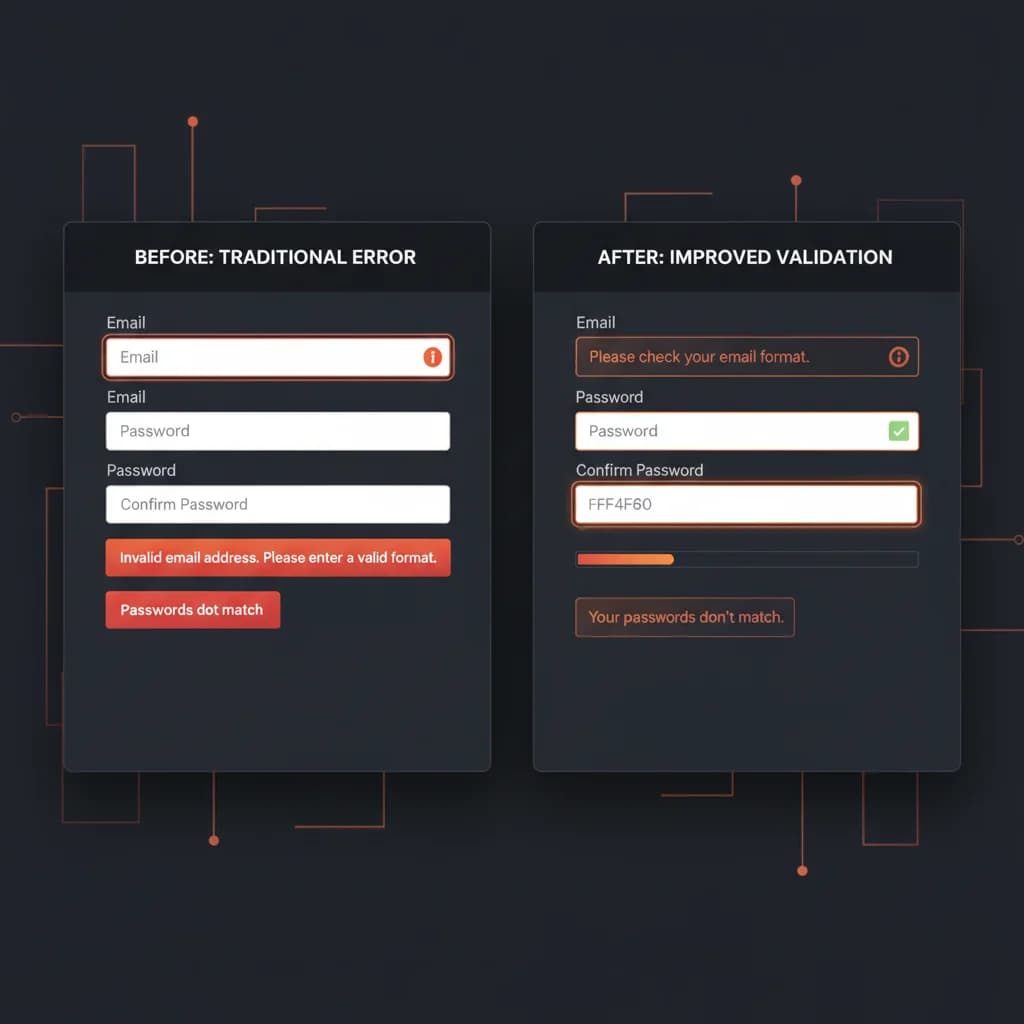
Intelligent Validation Engine
Conversational feedback with examples instead of generic error messages. 240+ custom validation rules with LLM semantic validation.
Adaptive Questioning
Shows only relevant fields based on previous answers, reducing perceived form length by 40% on average with industry-specific paths.
Progress Intelligence
Intelligent time estimation, section breakdown, milestone celebrations, and persistent session state across devices.
Session State Management
Auto-saves every field change with Redis hot storage, cross-device sync via WebSocket, and 30-day recovery window.
Smart Examples Library
Industry-specific examples from successful onboardings — automotive, aerospace, industrial — continuously updated and anonymized.
Measurable Business Impact
InputCoach deployment transformed Vertex’s onboarding bottleneck into a competitive advantage
Completion Rate Increase
39% → 82% in 90 days. Improvement visible within 2 weeks, stabilized by week 8. 2.1x improvement delivering 43% more completions.
Time Efficiency
4.2 → 1.4 hours average. Single-session completions jumped from 18% to 64%. Average sessions dropped from 3.7 to 1.6.
Revenue Recovered
43% more completions × $45K average value over 6 months. 3.7 week timeline shortening plus 34% higher expansion revenue.
Sales Engineering Load
20+ hours → 2 hours per customer. Team refocused on pre-sales demos, driving 17% deal velocity increase and $180K annual savings.
Data Quality
76% validation error reduction. Completeness: 91% → 98%. Integration accuracy: 89% → 97%. 43% less manual cleanup required.
NPS Increase
42 → 70 during onboarding. Customer effort score: 4.2 → 1.8. 52% support ticket reduction and 85% positive sentiment.
““Transformed what was a dreaded two-day process into a one-afternoon completion. It’s like having an implementation consultant sitting beside you.”
— Director of Procurement, Fortune 500 Automotive Manufacturer
Return on Investment (6 Months)
Technical Architecture & Innovation
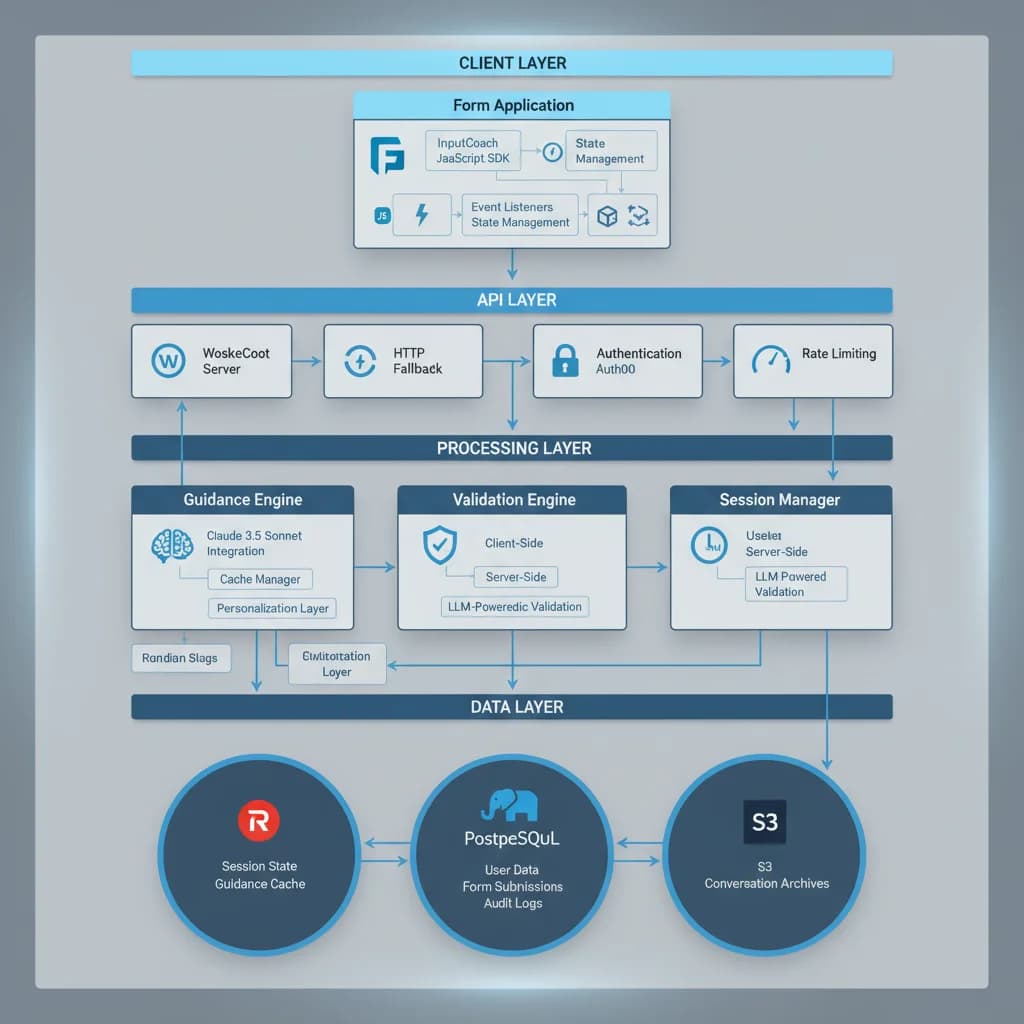
Claude 3.5 Sonnet (Anthropic)
AI EngineSuperior reasoning for contextual “why” explanations, multi-turn conversation tracking, 200K token context window. Custom system prompts with industry knowledge injection and 70% cache hit rate.
JavaScript SDK
Client IntegrationFramework-agnostic (React/Vue/Angular), 45KB gzipped with zero dependencies. Progressive enhancement with <200ms WebSocket delivery, HTTP polling fallback, and multi-tab sync via BroadcastChannel.
Redis + PostgreSQL
Data LayerRedis for hot sessions with 7-day TTL, PostgreSQL for long-term storage and audit trail. Real-time sync with conflict resolution and TLS 1.3 encryption throughout.
AWS Infrastructure
PlatformLambda auto-scaling supporting 10K+ concurrent sessions. VPC isolation with CloudWatch monitoring. Measured: <200ms guidance delivery, 99.97% uptime, 70% cache hit rate.
Similar Challenges, Proven Results
See how we have solved similar challenges in UX optimization and intelligent communication across industries.
Interested in Similar Solutions?
Have a Similar Challenge?
Let's discuss how we can help you achieve comparable results
Start Your Project